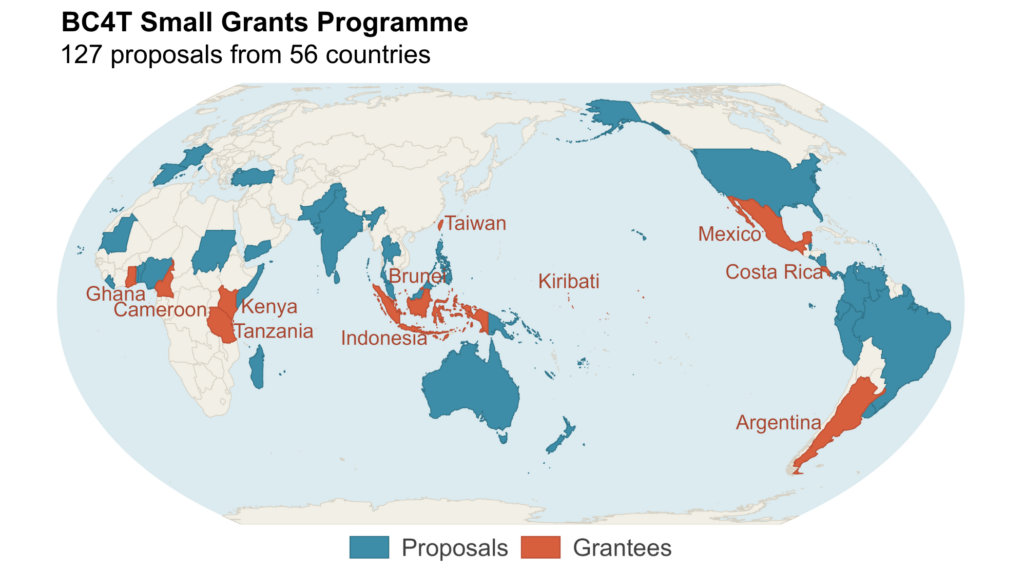




We are proud to announce the first recipients of the Blue Corridors for Turtles (BC4T) Small Grants Programme. The call drew an extraordinary response: 127 proposals from 56 countries, signalling how much appetite there is worldwide to close the data gaps standing between us and a fuller picture of marine turtle connectivity.
Grants have been awarded to projects spanning 11 countries across 3 continents: Ghana, Cameroon, Kenya, and Tanzania in Africa; Brunei, Indonesia, and Taiwan in Southeast Asia, along with Kiribati in the Pacific; and Mexico, Costa Rica, and Argentina across the Americas. Together, these projects reflect the transboundary, community-led spirit the Grant set out to support.
The Grant makes $50,000 USD available, alongside five satellite transmitters (two for leatherback turtles, three for hardshell species), to support community-engaged research that helps close critical gaps in our understanding of marine turtle movement and connectivity. It is disbursed by the State of the World’s Sea Turtles (SWOT) program, in partnership with WWF and Wildlife Computers, with proposals reviewed by a panel drawn from SWOT, WWF, and the University of Queensland. Priority went to projects addressing nesting locations, migratory patterns, or genetic connectivity, particularly those working across borders, strengthening regional collaboration, and actively involving local communities in the research itself.
Meet the recipients of the BC4T Small Grants
Africa
In Ghana, the Wildlife and Human Resources Organisation (WHRO Ghana), led by Andrews Agyekumhene, is working at one of the country’s most important nesting hotspots in the Greater Accra Region, tracing the origins of green turtles that forage there after migrating from rookeries across the Gulf of Guinea. In Cameroon, Biotope Network, led by Dr Bruno Zock, is training community monitors at Ebodjé to map nesting sites and collect the first substantial genetic samples from a stretch of coast almost absent from regional datasets.
In Kenya, the Olive Ridley Project – Kenya, led by Dr Joana Hancock, is following up a 2022 tracking study that revealed green turtles migrating south towards Mozambique, using genetic analysis to map a previously undocumented corridor. In Tanzania, Eva Johnson Ayaro, Managing Director of Women in Conservation Organization (WICO), is leading a community-assisted telemetry and genetics study of green turtles in the Rufiji seascape, combining satellite tracking and genetic sampling to reveal connectivity with Mafia Island and wider Western Indian Ocean corridors and strengthen conservation planning through the Blue Corridors for Turtles initiative.
Southeast Asia and the Pacific
In Brunei, a partnership led by Associate Professor Hie Lim Kim of Nanyang Technological University in Singapore, working with Universiti Brunei Darussalam, the Brunei Department of Fisheries and Laut Brunei, is establishing the country’s first systematic marine turtle monitoring in more than two decades. In Indonesia, Yayasan Anambas Kepulauan Indonesia, led by Novita Putri, is building a genetic baseline for the Anambas Islands, a nesting area at the crossroads of the South China Sea that remains under-represented in regional datasets.
In Taiwan, TurtleSpot Taiwan, led by Chia-Ling Fong, is generating genetic baselines for green turtles from Liuqiu Island, Taiping Island and Taiwan’s stranded-turtle archive. In Kiribati, the Ministry of Environment, Lands and Agricultural Development, led by National Turtle Coordinator Taunaari Tamango, is carrying out the first systematic, community-led survey of nesting beaches on Abaiang Island.


The Americas
In Costa Rica, Latin American Sea Turtles (LAST), led by Didiher Chacón Chaverri, is extending more than fifteen years of in-water hawksbill monitoring in Golfo Dulce, using satellite tracking to find the nesting beaches its resident females use. In Argentina, AquaMarina, led by Dr Victoria González Carman, is working with artisanal fishers at the species’ southernmost known foraging ground to track adult male leatherbacks, a life stage almost entirely unstudied in the South Atlantic.
In Mexico, Dr. Catherine Hart of Uella Environmental Research & Consulting is tracking critically endangered hawksbill turtles from the underrepresented Costa Careyes nesting site to identify migratory corridors and priority habitats, while sharing movement and long-term monitoring data to strengthen Blue Corridors for Turtles connectivity assessments and inform Important Marine Turtle Area planning in the eastern Pacific.
What is Blue Corridors for Turtles?
Blue Corridors for Turtles is a global initiative that, for the first time, connects satellite tracking data with genetic data, using ShellBank, to build a clearer picture of how marine turtle populations move and connect across the world’s oceans. Coordinated by WWF alongside CMS, the University of Queensland, SWOT, and CLS-Argos, and undertaken in support of the IUCN Marine Turtle Specialist Group’s mission, the project aims to close a long-standing gap: marine turtles are still the only major marine megafauna group without formally defined “important areas” for conservation planning. By aggregating nesting, tracking, and genetic data into a single connectivity baseline, BC4T is working toward the delineation of Important Marine Turtle Areas (IMTAs), finally giving marine turtles, and the communities connected to them, a seat at the policy table.
What happens next
The data these eleven grantee countries collect feeds directly into BC4T’s wider connectivity baseline, the same body of evidence that will ultimately support the identification of Important Marine Turtle Areas through regional workshops planned to begin under MTSG guidance by the end of 2026. Every dataset submitted moves through the project’s standard intake process: from initial contact through quality assurance before joining the combined geodatabase used for corridor and IMTA analysis. In this way, these eleven locally-led projects become part of a much larger global effort to chart the connectivity that will determine where and how marine turtles are protected in the years ahead.
For media enquiries, contact:
Lim Jia Ling
jllim@wwf.sg | +65 92980961
Jonah Kayguan
jkayguan@wwf.id | +63 9270661775
Special thanks
Special thanks to our supporters. Special thanks to our supporters. The small grant is co-funded by WWF-Netherlands, WWF-France, Novotel (the founding brand of the Accor group), with satellite transmitter donations from Wildlife Computers.