
Important Marine Turtle Areas
Where Connections Matter Most
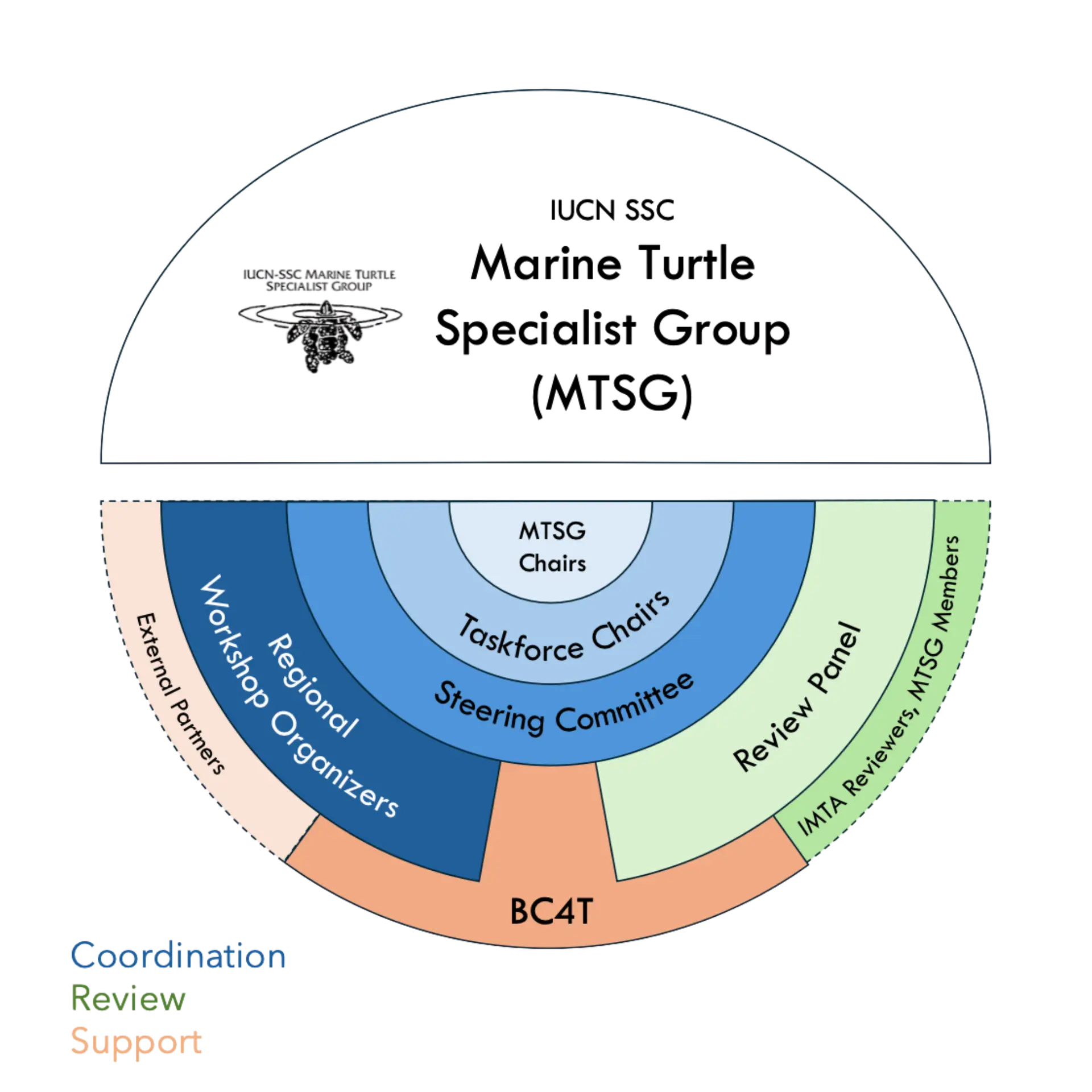
IMTAs are a global product of the IUCN-SSC Marine Turtle Specialist Group (MTSG). IMTAs are discrete areas that are particularly important for marine turtle population persistence, or where the contribution of marine turtles to local traditions and cultures is especially significant. Following Important Area processes already established for birds, marine mammals, sharks and rays, the marine turtle community is bringing the same approach to turtles. Their purpose is to support policy and management decisions. IMTAs are identified by regional experts and stakeholders using globally consistent criteria, ensuring that local knowledge and regional context remain at the centre of the process.
The MTSG’s IMTA Taskforce, launched in July 2026, coordinates this process with the support of Blue Corridors for Turtles, among other partners.
— Overview
What makes an area "important"?
The IMTA framework identifies places that are especially important for marine turtles and the people who live alongside them. Developed by the MTSG in 2021, IMTAs can recognise areas that are biologically significant for marine turtle persistence, culturally significant because of their importance to local traditions and communities, or both. Areas are evaluated against globally consistent criteria to determine whether they make a disproportionate contribution to the persistence of marine turtle populations. This may include providing habitat for threatened populations, supporting significant nesting, foraging or migratory aggregations, containing unique genetic or ecological characteristics, or sustaining exceptional biological or cultural diversity.
Regionally identified, globally consistent. IMTAs are identified through a regional, evidence-based workshop process that draws on scientific data, expert knowledge, and stakeholder input. This ensures local knowledge and regional context remain at the centre of the process while maintaining consistency across the global marine turtle range. Blue Corridors for Turtles supports this process by contributing data synthesis and knowledge products, technical and GIS expertise, and logistical support for regional workshops.
External Source

IMTA Criteria & Explainer
The IMTA process is delivered the IUCN-SSC Marine Turtle Specialist Group. The IMTA Guidelines 1.0 is available on their website.
Propose an Area of Interest (AoI) for the Mediterranean Regional IMTA Workshop
Submissions of AoIs for the Mediterranean region are now open. AoI proposals are required to meet the IMTA selection criteria and guidance provided. Thus, please be sure to review the guidance documents linked below (and again in the submission form) before making your submission. AoI proposals will be accepted for the Mediterranean region ONLY until 31 October 2026. All proposals will be evaluated during the Mediterranean Regional IMTA Workshop held in Greece from 8-12 November 2026, co-hosted by Archelon, the IUCN-SSC MTSG IMTA Taskforce and the BC4T team. At this workshop, decisions will be made about which proposals will progress as a candidate IMTA for independent review.
For questions about the Mediterranean IMTA process, you can email the RVCs at mtsgmed@gmail.com or the Taskforce Chair at: mtsg.imta@gmail.com.
Explore the IMTA Decision Support Tool
This mapping platform was built by the Blue Corridors for Turtles team to inform and support the MTSG’s mission of delineating IMTAs. The IMTA Decision Support Tool is a GIS platform developed to facilitate the exploration of contributed marine turtle and environmental data in support of users creating Area of Interest (AoI) proposals to be considered for designation as IMTAs.
The Tool connects various sources of spatial evidence (e.g., published research, monitoring data, expert knowledge) within a shared geospatial environment. Users are able to create, view, and manipulate spatial information without specialized desktop GIS software.
— Precedent
Building on approaches that already work
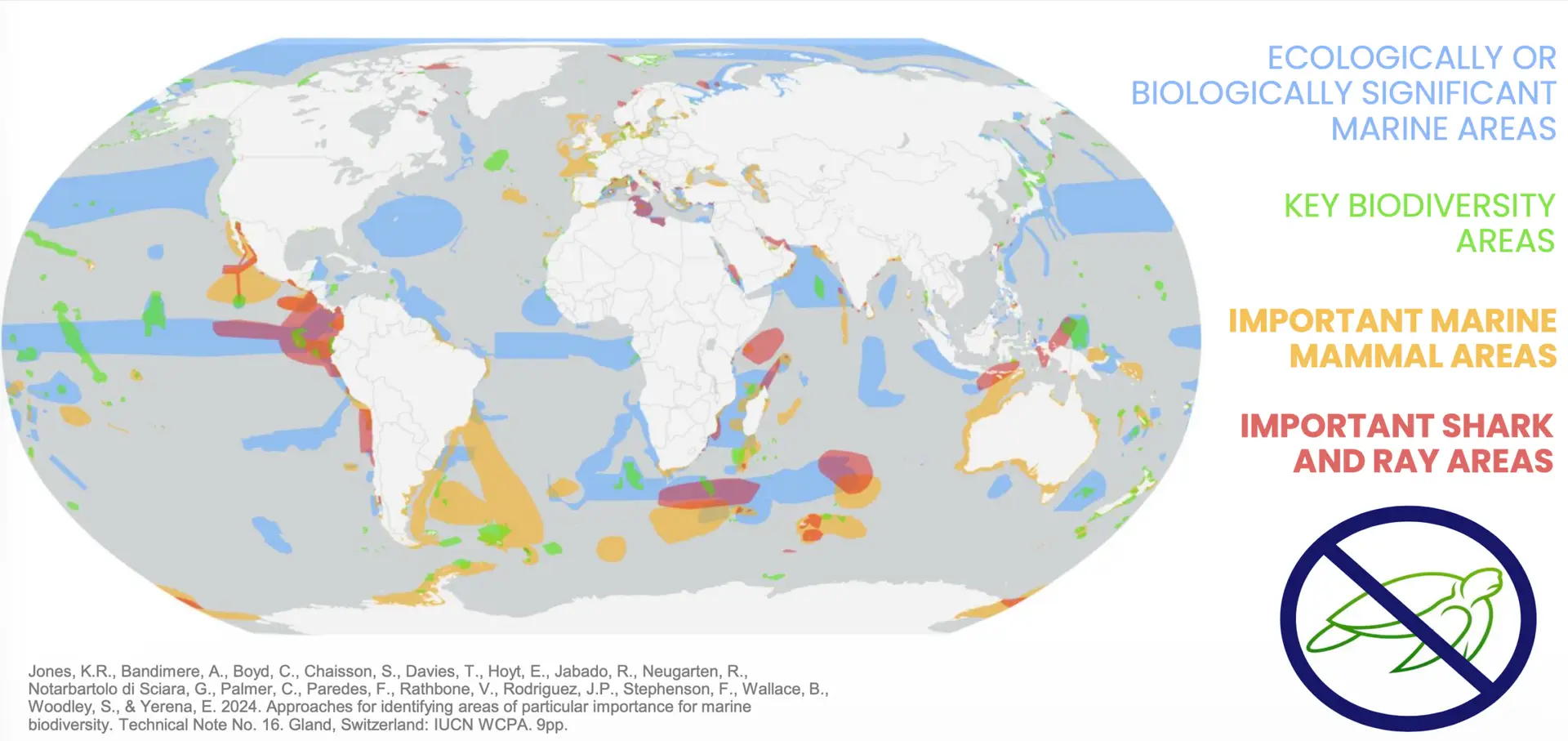
Marine turtles aren’t the first group to need this. Important Bird and Biodiversity Areas (IBAs) pioneered the approach of aggregating spatial movement data into a usable product for managers and that success led directly to greater inclusion of seabirds in EBSA descriptions, then to the creation of Important Marine Mammal Areas (IMMAs) and Important Shark and Ray Areas (ISRAs). Along the way, regional workshops proved essential, not only for drawing boundaries, but also for building lasting networks between researchers and local stakeholders. Marine turtles are the one major taxonomic group this process hasn’t yet reached; The IMTA framework deliberately follows the methods, and the lessons, those earlier processes established.
Already being mapped: EBSAs · IMMAs · ISRAs · KBAs
Why doesn't a single IMTA exist yet?
Marine turtles are a glaring omission at the conservation policy table compared to other marine megafauna. They are the only major group without formally defined “important areas,” which shuts them out of planning tools that rely on that designation. The barrier has never been a lack of will, but is rather rooted in a lack of funding, aggregated connectivity data, and coordination capable of integrating local knowledge into consistent, spatially explicit boundaries. The MTSG’s IMTA Taskforce now provides that coordination. Blue Corridors for Turtles has committed technical, logistical and financial capacity to support and operationalise the IMTA Taskforce. Specifically, BC4T offers support as a catalyst, facilitator, and technical contributor to the IMTA process.
— Why it matters
What an IMTA designation unlocks
Once designated, IMTAs give managers, communities and policymakers a common evidence-based reference point for turtle importance. The designation can inform decisions at multiple scales, from local management and fisheries planning through to national marine spatial planning, transboundary conservation initiatives and international policy processes.
Feeds biodiversity area frameworks
IMTAs provide evidence that can inform Key Biodiversity Areas (KBAs) and Ecologically or Biologically Significant Areas (EBSAs), marine spatial planning and other conservation prioritisation processes, frameworks marine turtles are currently underrepresented in.
Delivers on global policy targets
Supports national reporting and target delivery under the CBD’s Global Biodiversity Framework, the UN Sustainable Development Goals, CITES, CMS, among others.
Informs area-based protection
Guides the development of marine protected areas, other effective area-based conservation measures (OECMs), transboundary conservation areas, restoration priorities, and environmental impact assessments — within and beyond national jurisdictions.
Strengthens regional commitments; Works at national and local scales
Supports delivery of the Coral Triangle Initiative, the IOSEA and African Atlantic Turtle MOUs, the Inter-American Convention for the Protection and Conservation of Sea Turtles and the Secretariat of the Pacific Regional Environment Programme. As designation puts a site on the same footing as any other IMTA worldwide, national agencies, local authorities, and community managers can use it to justify and target their own national and local decisions.
— How an IMTA gets designated
From proposal to designation
Every IMTA moves through five stages, from an initial proposal to formal designation which typically takes over a six-month cycle.
1
Call for Areas of Interest
Anyone can propose an area, at least two months ahead of a regional workshop, using a standard submission form.
2
Initial
Review
Regional Workshop Organisers and the Steering Committee check proposals meet the technical guidance before the workshop.
3
Regional IMTA Workshop
A three-to-four-day workshop where experts and knowledge holders evaluate proposals together, resolve overlap, and put forward candidate IMTAs.
4
Independent Review
A Review Panel — including MTSG members from both inside and outside the region — assesses each candidate against the criteria.
5
Final Designation
The Taskforce Chair(s) finalise designations in consultation with the Steering Committee, based on the Review Panel’s recommendation.
— How areas are chosen
Two categories, five criteria
An area must first fall into one of two categories, then be justified against one or more of five selection criteria.
IMTA Categories
Biologically Significant
Important for nesting, feeding, migration corridors, or other life-cycle needs.
Culturally significant
Where marine turtles hold significant meaning in local traditions, heritage, or practices, unique to IMTAs.
IMTA Selection Criteria
Relative importance to the population
Disproportionately important to age classes, numbers, or other defining traits.
Species or populations of conservation concern
Critical habitat for species at high extinction risk.
Aggregations or congregations
Supports important concentrations, especially of multiple species or populations.
Distinctiveness
Sustains genetically, behaviourally, or ecologically distinct populations.
Diversity
Supports an important diversity of species, populations, or genetic lineages.
— POLICY CALENDAR
The window is open now
The framework moved from guidance in 2021 to process in 2026. These are the milestones that got it there, and what comes next.
2021
IMTA criteria established
Stemming from Regional Management Unit process, the MTSG published formal IMTA guidelines, but no area has been designated against them since.
2025
CITES CoP · UNOC · IUCN World Conservation Congress
A trio of major forums where marine turtle connectivity evidence started shaping policy conversations.
July 2026
IMTA Taskforce launched
The MTSG established a Taskforce to coordinate the process, chaired by Dr Chris Madden, with a Steering Committee, regional workshop organisers and an independent review panel.
March 2026
Convention on the Conservation of Migratory Species of Wild Animals
A resolution on IMTAs was published during the 15th Meeting of the Conference of the Parties to CMS (COP15) in Campo Grande, Brazil.
— PROGRESS
The Progress so far
Mediterranean IMTA Workshop
The first formal MTSG-led IMTA workshop will be held in Greece from 8-12 November 2026, co-hosted by Achelon and BC4T.
Case study
Hawksbills in the Northwest Atlantic
A proof-of-concept led by researchers across the Northwest Atlantic RMU pooled satellite tracks from 200 adult female hawksbills sampled across 18 countries and territories, modelled against known nesting sites. Contributors separated the tracks into migratory and foraging behaviour and used kernel density estimation to map where each concentrated, then overlaid that against coastal fishing pressure to see where turtles and threats intersect most. The resulting boundaries are strictly hypothetical, meant only to illustrate how the method works once genetic stock data is layered in next. Find this example in the BC4T report (2025), p.40-43.
— TARGETING DATA GAPS
Where the evidence is thinnest
The IUCN’s Regional Management Unit framework shows where genetic and connectivity data are so limited it may impede on delineation of an IMTA. These are the MTSG’s priority regions for new data collection. Explore BC4T’s Small Grant Programme, aiming to help fill the gaps.
Explore BC4T’s Small Grants Programme
From 2025, we’ve released a small grants programme to help fill data gaps in marine turtle connectivity and distribution.
Hawksbill turtles
Northeast Indian Ocean, Pacific Southeast Asia, South Central Pacific, and West Central Pacific.
Green turtles
West Central Pacific.
Loggerhead turtles
Northeast Atlantic, Northeast Indian Ocean, and Northwest Indian Ocean.
Olive Ridleys
West Indian Ocean and the West Pacific.
Leatherbacks
West Pacific; alongside hawksbills, the species with the greatest overall conservation capacity gaps.